
 Tilda Eriksson
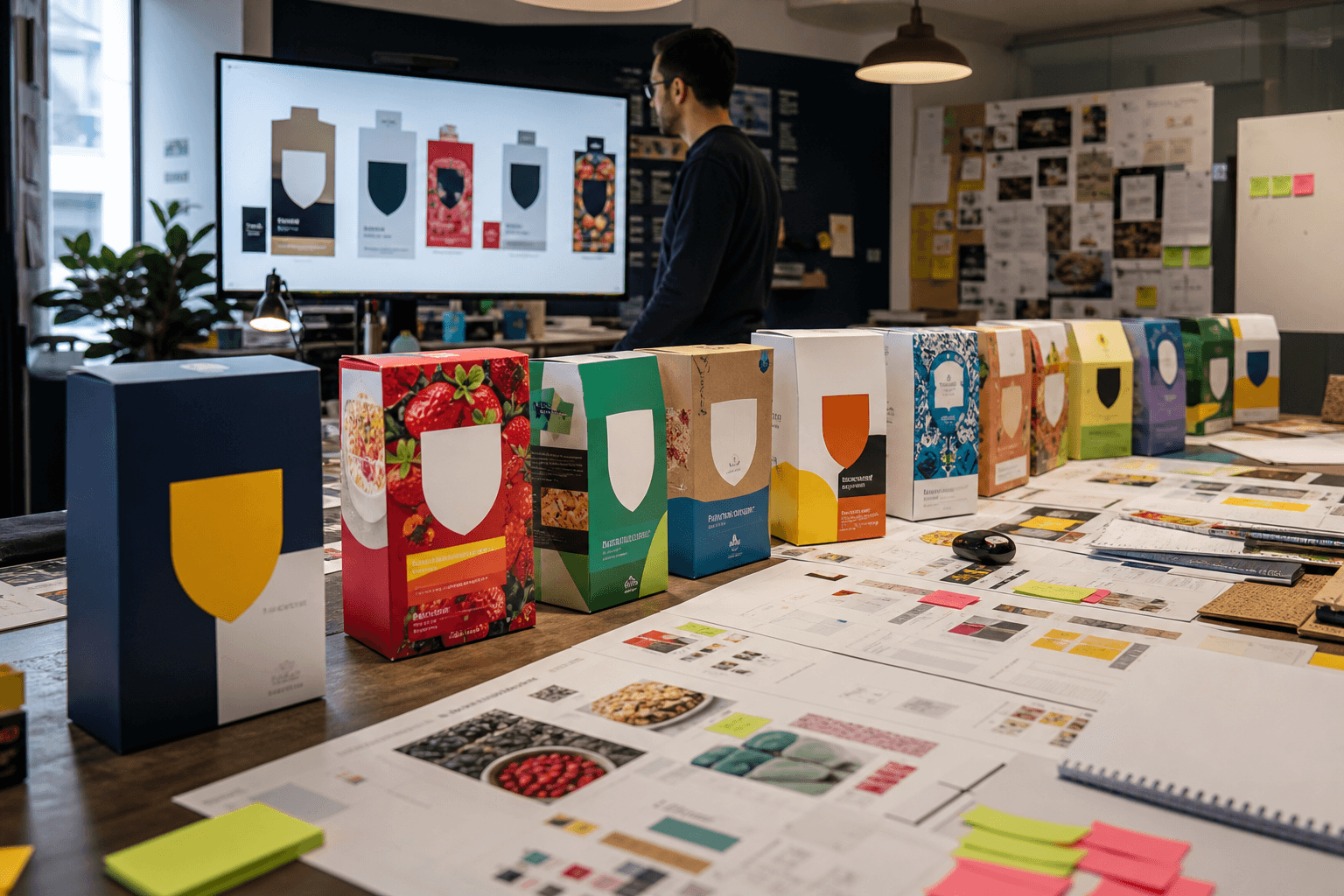
Every multi-market brand has had this moment. The global brand team presents a clean set of packaging guidelines: the logo zone, the colour system, the hierarchy of information, the photography style. Everyone nods. Six months later someone lines up the packs from Sweden, Norway, Finland, Poland and the UK on one table, and they look like five cousins who've never met.
Nobody broke the rules on purpose. Each local team made reasonable decisions under local pressure: a retailer asked for a different barcode position, a new regulation added two lines of text, a translation ran 30% longer than the English original, a supplier's template had slightly different dimensions. Each change made sense on its own. Added together, they amount to a brand that no longer looks like one brand.
The problem usually isn't the guidelines themselves. It's that they never answer the question local teams actually face every week: what am I allowed to change, and what am I not?
Why guidelines drift once they reach local markets
Brand guidelines are typically written to describe what the brand looks like. They're much less often written to describe how the brand should behave when it has to change. And in packaging, change is constant.
Drift tends to come from three places:
Ambiguity about decision rights. When a guideline doesn't say whether the claim area can be resized for a longer translation, the local designer decides. Multiply that by fifteen markets and every pack ends up solving the same problem differently.
Different starting files. This one is the most underestimated. When a local team needs to adapt a pack, they rarely start from the validated global master. They start from the last file someone sent them, often a previous local version that already contains earlier deviations. Drift compounds, one adaptation at a time.
Late discovery of local requirements. Regulatory text, allergen formats, deposit markings and retailer-specific codes are often discovered after the artwork is well underway. The fix is then squeezed into whatever space is left, and the layout pays the price.
None of these are design problems. They're structural ones, and they need a structural answer.
The fixed / flexible / local-only model
The most useful exercise a multi-market brand can do is to sort every element of its packaging into three categories.
Fixed elements are identical in every market. They carry brand recognition, and changing them locally would weaken the brand everywhere. Typically: logo and its placement, core colour system, brand typography, key visual structure.
Flexible elements follow a global rule but have a defined range of adaptation. The rule says how they may change, not just that they may. Typically: product name length, claim wording, image cropping, the size of the information zone.
Local-only elements are owned entirely by the market, because they're driven by language, law or retail. Global has no opinion on their content, only on where they sit. Typically: legal text, nutrition tables, deposit and recycling markings, retailer codes, importer details.
Here's what that can look like in practice for a typical FMCG pack:
| Element | Category | Who decides | Adaptation rule |
|---|---|---|---|
| Logo & logo zone | Fixed | Global | Never moved or resized |
| Colour system | Fixed | Global | Only print-driven adjustments, approved centrally |
| Brand typeface | Fixed | Global | Local scripts use the approved fallback font |
| Product name | Flexible | Global rule, local execution | May wrap to two lines; minimum size defined |
| Front-of-pack claims | Flexible | Global list, local selection | Chosen from an approved claim library |
| Hero image | Flexible | Global | Crop within defined safe area only |
| Legal & regulatory text | Local-only | Local (regulatory) | Placed in the defined information zone |
| Nutrition / allergen panel | Local-only | Local (regulatory) | Follows local format inside the fixed zone |
| Recycling & deposit marks | Local-only | Local | Positioned in reserved area |
| Retailer codes & barcodes | Local-only | Local | Positioned in reserved area |
The value of the table isn't the specific answers, which will differ from brand to brand. The value is that the answers exist, are written down, and are agreed on before the next adaptation starts. Once local teams know exactly what they own and what they don't, most drift disappears without anyone having to police it.
A useful test: if a local designer has to email the global team to ask whether something is allowed, the model isn't clear enough yet.
Start every market from the same file
A clear model only works if everyone starts from the same place. This is where many standardisation efforts quietly fail. The rules are agreed, but the files aren't.
The fix is conceptually simple: one validated master per design, stored in one controlled place, with version control that makes it obvious which file is current. Every local adaptation starts from that master, not from a colleague's previous version, not from a supplier's archive, and not from "the one we used last time".
When this is in place, several things change at once. Errors from outdated elements stop reappearing in new markets. Global updates, like a refreshed claim or a new recycling mark, can be pushed to every market from one point. And the question "which version is correct?" stops eating up review rounds.
We've written before about the day-to-day side of this in 3 ways to maintain brand consistency across multiple markets. The masters are what make those habits hold at scale.
Treat market rollout as a playbook, not a project
Even with clear rules and shared masters, many brands still treat every new market launch as a one-off project. A new team is assembled, the requirements are researched from scratch, and the timeline is guessed.
A playbook approach turns rollout into a known sequence. The steps, the required assets, the local requirements to collect, the approvals and their owners are all defined in advance. The second market launch should be faster than the first, and the fifth should be almost routine.
A rollout playbook usually covers:
- Intake: which local requirements (language, regulation, retailer) must be collected before any artwork starts
- Adaptation: which master to use, and which elements the local team adapts according to the fixed / flexible / local-only model
- Review: who checks what, in which order, with local regulatory review built in as a defined step
- Release: who gives final approval, and how the approved file is handed to print and to downstream channels like e-commerce
This is the heart of what it takes to standardize global packaging without flattening local relevance: a shared framework that local teams execute against, instead of each region inventing its own version of the process.
Build compliance into adaptation, not after it
One detail deserves its own section, because it causes a disproportionate share of late changes: local compliance requirements.
When regulatory text and markings are treated as a final check, they're discovered after the layout is set. Something has to give, and it's usually the design. When the same requirements are collected at intake and given a reserved space in the master layout, they slot in without disrupting anything.
This is becoming more important, not less. With regulations like the EU's PPWR changing labelling and marking requirements over the coming years, brands will need to update packaging across many markets at once. Brands with a structured adaptation process will handle that as a planned rollout. Brands without one will handle it as fifteen separate emergencies.
What this looks like in practice: Kavli
Kavli is a good example of how this plays out. The company operates across several markets with independent entities, different suppliers and overlapping portfolios. That setup increases risk every time a product is reused or adapted for another market.
What started as a single adaptation project for Kavli Norway revealed that the real need wasn't just adapting one product. It was a repeatable way to manage artwork across markets. By testing not only the execution but also the process and approval logic, and involving design and artwork vendors early, the project became the foundation for centralised, portfolio-level artwork control rather than another one-off.
You can read more about that project, and others like it, on our work page.
Where to start
You don't need a full transformation programme to make progress. Three steps get most brands a long way:
- Run the sorting exercise. Take one product family and classify every element as fixed, flexible or local-only. Disagreements between global and local teams during this exercise are useful: they show you exactly where drift has been coming from.
- Find your real masters. Establish which files every market is actually starting from today. The answer is often surprising.
- Document your next rollout as you do it. Turn the next market launch into the first draft of your playbook.
If you'd like an outside view on where your global and local packaging is drifting, and what a repeatable model could look like for your portfolio, talk to Collabra. Our design team works with multi-market brands on exactly this balance: keeping the brand recognisable everywhere while letting every market meet its own requirements.
