
 William Janeway
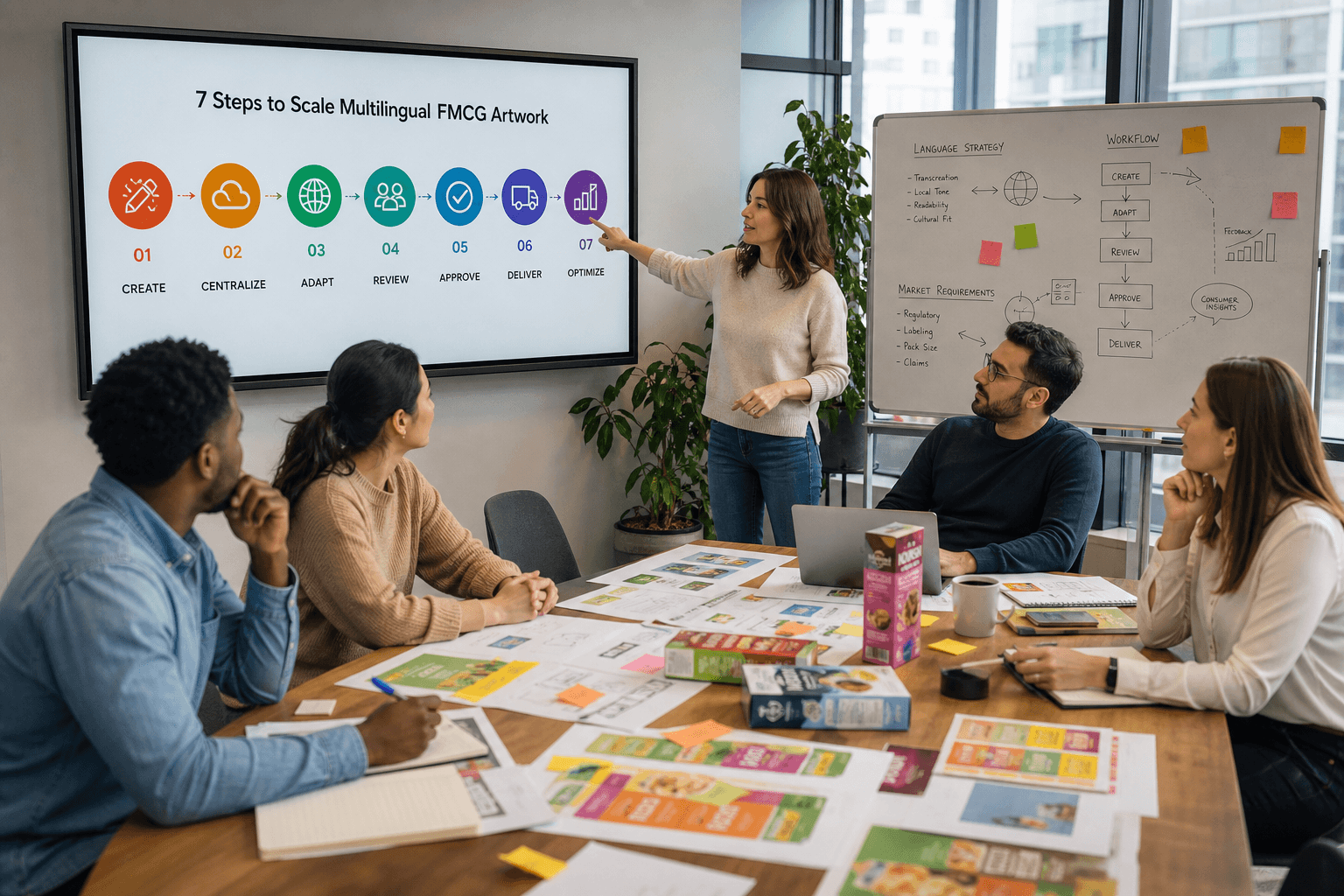
Launching one product in one market is simple. Launching 200 SKUs in 12 languages, with different legal rules in every country, is not. For FMCG brands expanding across Europe, multilingual packaging is where launch dates slip, costs grow, and reprints happen.
The good news: scaling multilingual artwork is not about working harder. It is about making the right decisions early, in the right order. This guide walks through seven steps that packaging teams use to scale across markets without losing quality or speed.
It is based on how Collabra, a packaging agency in Gothenburg with more than 20 years of FMCG experience, plans and delivers multi-market packaging for food and consumer goods brands.
Quick summary: 7 steps to scale multilingual artwork
- Audit your portfolio and market mix
- Choose your language and pack strategy
- Build a master design made for translation
- Lock and approve source text before design
- Plan regulatory checks for every market
- Produce language versions at scale
- Roll out in waves and improve each round
Why multilingual FMCG artwork is hard to scale
Every new language multiplies your work. One master design can become dozens of versions once you add languages, pack sizes, and market-specific rules. Each version needs correct translations, correct legal text, and correct technical files.
Most problems do not come from the design itself. They come from:
- Text that does not fit: translations are often longer than the original, and the layout breaks
- Late text changes: a claim or ingredient changes after translation, and every version must be updated
- Different legal rules: each market has its own requirements for claims, allergens, and recycling marks
- Too many handoffs: strategy, design, translation, and print are handled by different suppliers who don't share the full picture
The seven steps below address each of these problems at the right stage.
Step 1: Audit your portfolio and market mix
Before you design anything, get a clear picture of what you are scaling. Map every SKU against every market where it will be sold. Note pack formats, current languages, retail partners, and launch dates.
This audit often shows that the work is smaller, or very different, than expected. Some SKUs may not need to launch in every market. Some formats can be merged. Some markets share almost the same requirements.
Questions to answer in your audit:
- Which SKUs launch in which markets, and when?
- Which pack formats and sizes are in scope?
- Which markets share a language or similar legal rules?
- Where have past launches caused delays or reprints?
How Collabra helps: Collabra's packaging strategy team starts every multi-market project with this kind of analysis. Mapping the portfolio first shows where complexity can be reduced before any design work begins, which saves time and cost in every later step.
Step 2: Choose your language and pack strategy
This is one of the most important decisions in multi-market packaging, and it is often made too late. You have two basic options:
- Single-market packs: one language (or one market) per pack. Clear and easy to read, but more SKUs to produce, store, and manage.
- Multi-language packs: several languages on one pack, for example a shared Nordic pack for Sweden, Norway, Denmark, and Finland. Fewer SKUs and simpler logistics, but less space per language.
Most brands use a mix. A high-volume product may get a shared regional pack, while a premium product gets single-market packs with more room for storytelling.
Things to weigh:
- Available space on each pack format
- Legal minimum text sizes in each market
- Stock flexibility: can one pack be moved between countries?
- Shelf impact: does the front of pack stay clean and recognizable?
How Collabra helps: Collabra helps brands decide which language combinations make sense for each product group. This choice affects production cost, supply chain flexibility, and shelf impact, so it belongs in strategy rather than being left to the design phase.
Step 3: Build a master design made for translation
A master design is the base that all language versions are built from. If it is designed only for English or Swedish, it will break as soon as you add German, Finnish, or French, which often need noticeably more space.
A translation-ready master design has:
- Flexible text areas that can grow without breaking the layout
- A clear hierarchy that works in any language
- Fixed brand elements (logo, colours, key visuals) that stay the same everywhere
- Defined zones for legal text, so they don't compete with brand messaging
- Icons instead of words where possible, to reduce text volume
Test your master design with your longest language before you approve it. A layout that works in English but fails in German will cost far more to fix later.
How Collabra helps: Collabra's designers build master designs with multi-market rollout in mind from day one. Because the same agency also handles production, design decisions are tested against real language and format needs before they are locked.
Step 4: Lock and approve source text before design
Late text changes are one of the biggest causes of delay in multilingual projects. If a claim changes after ten translations are done, every version must be updated, checked, and approved again.
The fix is simple but needs discipline: finalize and approve all source text before translation and adaptation begin. Keep all packaging text in one structured document, often called a copy deck, with one row per text element and one column per language.
Best practices for source text:
- Get marketing, legal, and quality teams to approve text in one round
- Use native-speaking translators with packaging and food experience
- Keep a reviewed glossary of product names and key terms
- Record every text change with a date and an owner
How Collabra helps: Collabra structures and coordinates packaging text so translation, review, and adaptation follow a clear order. This reduces review rounds and stops late changes from spreading across dozens of versions.
Step 5: Plan regulatory checks for every market
Every market has its own rules. In the EU, food labelling follows Regulation (EU) No 1169/2011, which sets requirements for mandatory information, allergen emphasis, and minimum text size. On top of that, countries add their own rules, such as national recycling marks, deposit symbols, or claim restrictions.
Packaging regulation is also changing. The EU Packaging and Packaging Waste Regulation (PPWR) introduces new requirements for recyclability and labelling over the coming years, which means packaging updates will be needed across many portfolios.
A good regulatory plan includes:
- A checklist of required elements per market
- Clear owners for regulatory review in each country
- Review timing that fits your launch schedule
- A way to update all affected versions when rules change
How Collabra helps: Collabra plans regulatory checks as part of the project schedule, not as an afterthought. With experience across European markets, Collabra helps brands prepare packaging for both current rules and upcoming changes like PPWR.
Step 6: Produce language versions at scale
Once the master design, source text, and regulatory requirements are ready, production can scale. This is where approved designs become print-ready files for every language, size, and format.
At scale, accuracy depends on a consistent process:
- Adapt from the approved master, never from an older version
- Check every version against the approved text and regulatory checklist
- Verify technical details such as barcodes, colours, and print specifications
- Compare each version with the master before files go to print
- Deliver clearly named files so printers always use the correct version
Small errors, like a wrong allergen or a missing translation, can lead to costly reprints or product recalls. Careful production is what protects the investment made in strategy and design.
How Collabra helps: Collabra's production team adapts master designs into every language and format version, handles prepress, and delivers print-ready files. Having strategy, design, and production in one agency means fewer handoffs and fewer chances for errors to reach the printer.
Step 7: Roll out in waves and improve each round
Trying to launch every market at once increases risk. A wave-based rollout lets you launch in a few markets first, learn, and then scale.
How to plan your waves:
- Start with markets that have the clearest requirements or the earliest retail dates
- Time each wave around stock run-out, so old packaging is not wasted
- Collect feedback from printers, retailers, and local teams after each wave
- Update your master design and processes before the next wave
Each wave should make the next one faster. Over time, your templates, glossaries, and checklists become a real advantage that makes every future launch easier.
How Collabra helps: Collabra plans rollouts backwards from retail dates and coordinates directly with printers and co-manufacturers. Lessons from each wave feed into the next, so brands get faster and more accurate with every market they add.
Common mistakes when scaling multilingual artwork
- Designing for one language first and adapting later
- Translating before the text is final, which forces repeated updates
- Treating regulatory review as a final step instead of planning it from the start
- Using several suppliers for strategy, design, translation, and print with no shared overview
- Launching all markets at once without testing the process in smaller waves
When to bring in a packaging partner
Many brands handle a few markets with their own team. A packaging partner becomes valuable when:
- Your portfolio grows to many SKUs across several markets
- You are planning a redesign, rebrand, or regulatory update across the whole range
- Launches keep slipping because of late changes or reprints
- Your team spends more time coordinating suppliers than making decisions
Collabra works as one partner across packaging strategy, design, and production. This gives FMCG brands one team that understands the whole process, from portfolio decisions to print-ready files in every language.
