
 Tilda Eriksson
1 min read
11 benefits of online proofing software
 Ekaterina Skalatskaia : 2024-04-29 10:02
Given the whirlwind nature of product launches, where timing is critical and perfection is imperative, ensuring your artwork proofing process is...

Most artwork operations do not become complicated overnight. They grow gradually as teams add new markets, stakeholders, systems and workarounds to keep projects moving.
The result can be a process that works, but is difficult to manage, measure or scale. A clear packaging operating model helps bring structure back by defining roles, handoffs, decision points and KPIs. This article looks at the signs that your artwork process has outgrown its original setup—and where to start fixing it.
Artwork operations are all the people, steps and rules needed to take packaging from a brief to a print-ready file. This includes briefing, design adaptation, artwork production, content review, approvals, proofing and handover to the printer.
In many companies, nobody owns artwork operations as a whole. Brand owns the brief, regulatory owns the text, the artwork studio owns the files and supply chain owns the printer. Each part works on its own, but the full process has no clear design.
At Collabra, we have worked with packaging for FMCG brands for more than 20 years and across 600+ artwork programs. We rarely find artwork operations that were planned from the start. Most of them grew over time, as teams solved one problem after another.
Artwork operations grow by accident when teams fix problems one at a time without looking at the whole process. Each fix makes sense on its own. Together, they create a process that is slow, hard to follow and dependent on a few key people.
It usually happens like this:
After a few years, the process works, but only because experienced people know how to get around it. When one of them goes on holiday or leaves the company, everything slows down.
If several of these sound familiar, your artwork operations were probably not designed:
We describe the most common errors this kind of process creates in how to eliminate common packaging mistakes.
A packaging operating model is a clear description of how artwork work should flow through your organisation. It defines who does what, when work moves from one team to the next, who makes each decision and how you measure the results.
An operating model is not an org chart. An org chart shows who reports to whom. An operating model shows how work actually moves.
A packaging operating model usually has five parts:
| Part | What it defines | Example question it answers |
|---|---|---|
| Process stages | The fixed steps every job goes through | What happens after the brief is approved? |
| Roles | Who does the work at each stage | Who updates the artwork file? |
| Handoffs | When and how work moves between teams | What must be ready before artwork starts? |
| Decision points | Who has the authority to approve or stop a job | Who can release a file to print? |
| KPIs | How you measure whether the process works | How many revisions does an average job need? |
When these five parts are clear, people stop guessing. They know what to do, who to hand work to and what "done" means at each step.
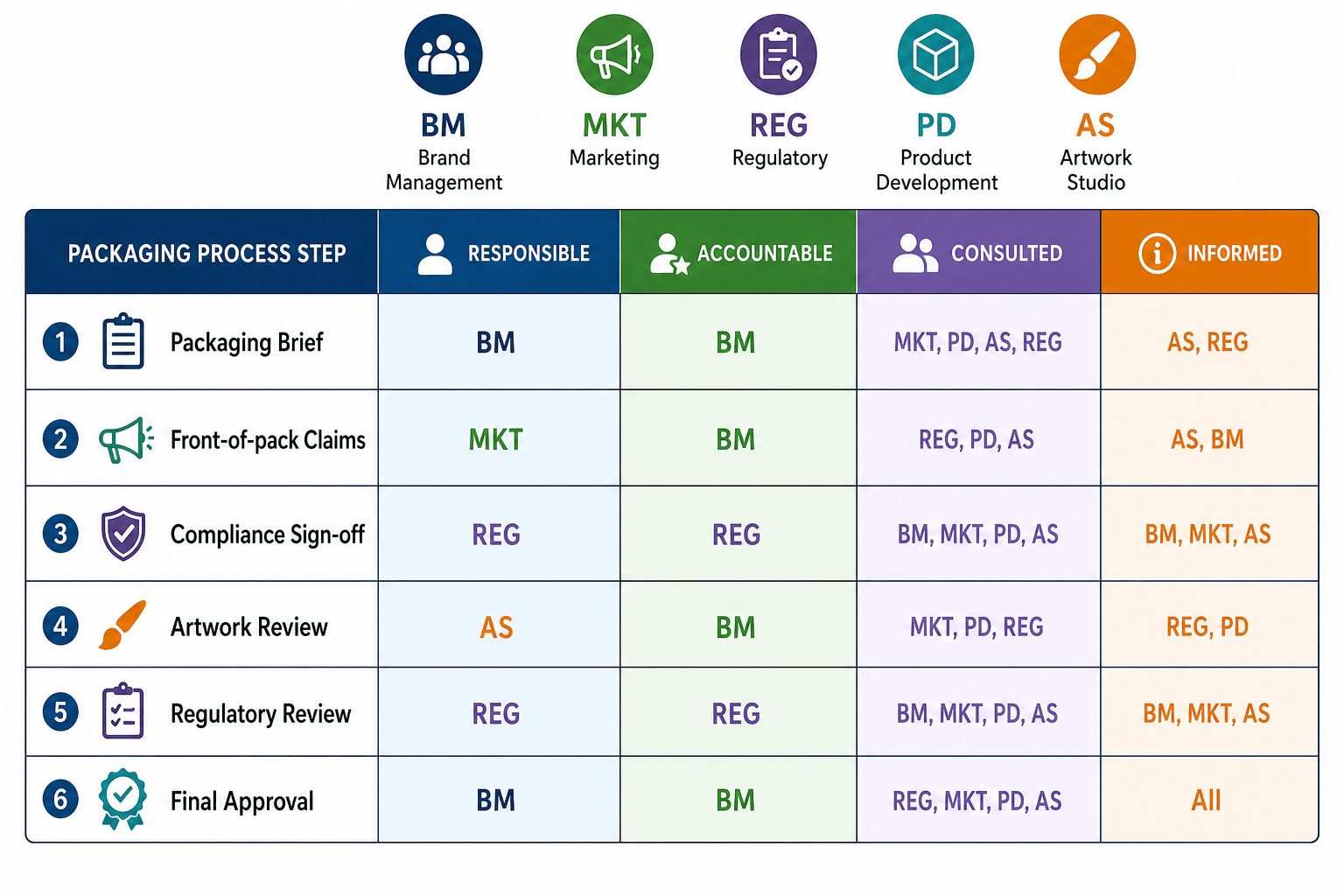
Clear decision points are closely linked to clear ownership. If you want to go deeper on that, see our guide to building a packaging approval RACI.
You should fix the process before you automate it because automation copies the process exactly as it is. If the process has unclear steps, extra review rounds and missing owners, automation will run those problems faster and at larger scale.
The right order is:
This is also how we work at Collabra. We do not start with software. We start by understanding how work moves today. Technology comes after the process holds, whether that is Cway or the artwork management system a company already uses.
If you are planning to invest in automation, our article on packaging automation readiness explains what to check first.
Four KPIs give a clear picture of artwork operations performance. They are simple to measure and easy to understand for everyone involved:
Measure these before you change anything. Without a baseline, you cannot show that the new operating model is working.
In our work with Santa Maria, which covered more than 600 artworks across markets, suppliers and printers, Collabra designed the artwork architecture and planning logic before production started. The project reached an average of 1.5 revisions per artwork, with predictable timelines. You can read more about this and other projects on our work page.
You start an artwork process redesign by looking at how work really happens today, not how it is supposed to happen. A simple way to begin:
This exercise often shows that most delays come from a small number of steps. Those are the places to fix first.
Collabra is a packaging agency based in Gothenburg, Sweden. We help brand owners with packaging strategy, design and production, including artwork production, proofing and print management.
Because we work inside packaging operations every day, we see where processes break down in practice. We use that experience to help brands transform artwork operations: we map the current process, redesign it, define a packaging operating model and set up KPIs to track the results. Automation comes last, when the process is ready for it.
A good first step is a Packaging Operations Health Check. It shows where your artwork operations lose the most time and which changes will have the biggest impact.


1 min read
Ekaterina Skalatskaia : 2024-04-29 10:02
Given the whirlwind nature of product launches, where timing is critical and perfection is imperative, ensuring your artwork proofing process is...
1 min read
 Tilda Eriksson : 2026-10-05 10:30
Packaging approvals often involve many people, but that does not always mean ownership is clear. When brand, regulatory, QA and artwork teams are all...

1 min read
Ekaterina Skalatskaia : 2025-02-18 09:00
Think about this: every symbol, claim, or piece of text on a package has a purpose. It's there to meet regulatory requirements, convey essential...