Packaging approvals often involve many people, but that does not always mean ownership is clear. When brand, regulatory, QA and artwork teams are all involved, it can be difficult to know who makes the final call at each stage.
A packaging approval RACI removes that ambiguity by defining who is responsible, accountable, consulted and informed—from the initial brief through final release. This article explains how to structure one, avoid common ownership gaps, and keep compliance and approval decisions moving.
Key takeaways
- A packaging approval RACI shows who is Responsible, Accountable, Consulted and Informed at each step, from brief to print.
- Most packaging compliance errors happen because ownership is shared. When everyone owns a check, no one really does.
- The most important rule is simple: each step should have exactly one Accountable person.
- Compliance sign-off and final release should be two separate steps with two separate owners.
- New rules like the EU's PPWR create new compliance tasks. Each one needs a named owner.
What is a packaging approval RACI?
A packaging approval RACI is a table that shows who does what in the packaging approval process. For each step, such as writing claims, checking regulatory text or releasing artwork to print, it names who does the work, who makes the decision, who gives input and who needs to know.
The goal is to make ownership clear before a file starts moving between people. When ownership is clear, compliance checks are not left to chance.
At Collabra, we have worked with packaging for FMCG brands for more than 20 years. In that time, we have seen the same pattern again and again. Most packaging errors are not caused by people doing a bad job. They are caused by people who are not sure which job is theirs.
Why do packaging compliance checks get missed?
Packaging compliance checks get missed because too many people share responsibility for them. A single pack can involve brand, marketing, product development, regulatory, quality, a design agency, an artwork studio and a printer. When everyone is involved, it is easy to assume someone else checked the details.
A typical example looks like this:
- Marketing reviews the allergen text and assumes regulatory has approved it.
- Regulatory approves the text, but in an older version of the file.
- The artwork studio makes a final change and expects the brand manager to check it.
- The brand manager sees that several people reviewed the file and approves it.
Everyone did what they thought was their job. But no single person owned the compliance decision.
We see three common causes behind this:
- Shared ownership. If "the team" owns a check, nobody owns it.
- Review mixed with approval. Many people comment on artwork. Few are clearly allowed to decide. When feedback and approval happen in the same email thread, it is hard to tell a suggestion from a requirement.
- Approval by availability. When the usual approver is away, the file goes to whoever is free, often without the right knowledge.
These gaps are expensive. We explain the real cost of late packaging mistakes in the cost of getting packaging graphics wrong.
What do R, A, C and I mean in packaging?
RACI stands for four roles. Each person or team gets one role for each step in the process:
- Responsible (R): the person who does the work. Example: the artwork studio updates the file.
- Accountable (A): the person who makes the final decision and owns the result. There should be only one A per step.
- Consulted (C): people who give input before the decision is made.
- Informed (I): people who are told about the decision after it is made.
The rule that matters most is one step, one Accountable. If two people are accountable for approving regulatory text, it becomes unclear who has the final say.
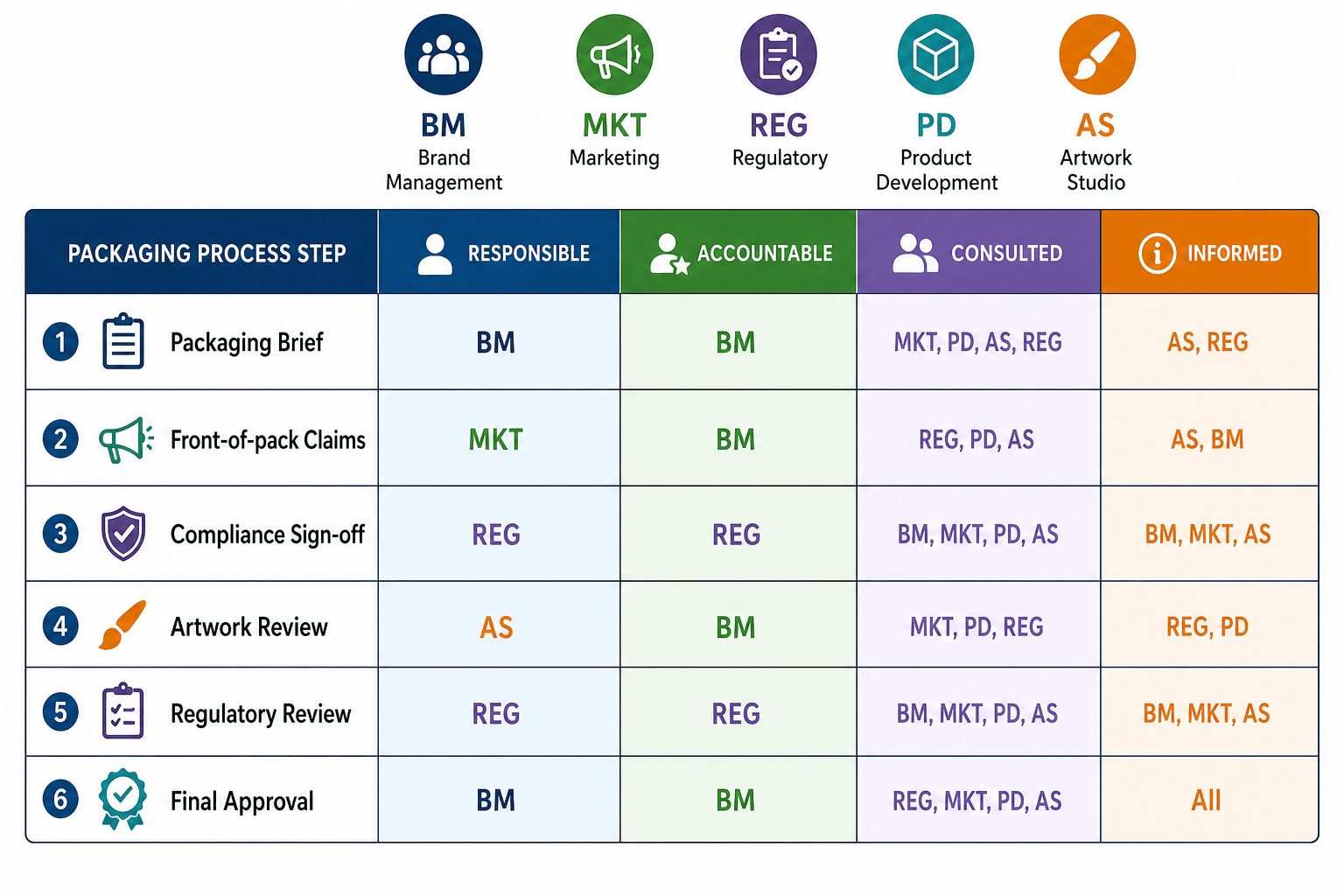
Example RACI matrix for packaging approvals
Below is an example RACI matrix for a typical FMCG packaging process. You can use it as a starting point and adjust the roles to fit your own team.
| Step |
Brand manager |
Marketing |
Regulatory / QA |
Product development |
Artwork studio |
Print / Supply chain |
| Packaging brief |
A |
R |
C |
C |
I |
I |
| Product data & ingredients |
I |
I |
C |
A/R |
I |
— |
| Front-of-pack claims |
C |
R |
A |
C |
I |
— |
| Regulatory & legal text |
I |
I |
A/R |
C |
I |
— |
| Artwork creation & changes |
C |
C |
I |
I |
A/R |
— |
| Content review |
R |
R |
R |
R |
C |
— |
| Compliance sign-off |
I |
I |
A |
C |
I |
— |
| Final artwork release |
A |
I |
C |
I |
R |
I |
| Print approval / proof |
C |
— |
I |
— |
R |
A |
Three things to notice in this example:
- Compliance sign-off and final release are separate. The brand manager decides when a pack is released, but cannot overrule a compliance decision. That belongs to regulatory.
- Product development owns product data. Many compliance errors start when ingredients or nutrition values change after artwork work has begun. A clear data owner closes this gap.
- Many people review, one person decides. Content review can have several Rs. Compliance sign-off has only one A.
What are the most common RACI mistakes?
A RACI only works if it changes how people actually work. These are the five mistakes we see most often:
- Too many Accountables. If a step has two As, split it into two steps or choose one owner.
- Too many Consulted. Every C is someone you must wait for. Move people to I where you can.
- Departments instead of names. "Regulatory" is a team, not an owner. Name one person per market or category, plus a backup for holidays.
- Not connected to the workflow. A RACI in a slide deck changes nothing. Approval requests must go to the right people, and it must be clear who approved what.
- Never updated. Teams, markets and rules change. Review the RACI at least once a year.
How does PPWR change compliance ownership?
The EU's Packaging and Packaging Waste Regulation (PPWR) adds new requirements for packaging, including recyclability, material information and harmonised sorting labels. For many brands, these are new tasks that no existing role clearly owns.
Questions your RACI should answer include:
- Who confirms the recyclability grade of each pack?
- Who checks that sorting labels are correct for each market?
- Who decides when a pack must be updated because its material has changed?
If these questions do not have named owners, they will be handled by whoever notices first, or not at all. We cover the key PPWR deadlines in PPWR and packaging: what brands must do before 2030.
How to set up a packaging RACI in 5 steps
You do not need a reorganisation to build a packaging RACI. In most cases, it simply writes down responsibilities that already exist informally.
- Map how work really flows today. Document how a pack moves from brief to print, including the unofficial steps and workarounds.
- Build the RACI together. Bring brand, regulatory, product development and the artwork team into one meeting. The points you disagree on are your real gaps.
- Test it on one product family. Use it on real projects for a few weeks and adjust it.
- Connect it to your approval process. Make sure approval requests reach the right person and that every decision is recorded.
- Review it regularly. Update it when you add a market, a category or a new regulation.
For guidance on what compliance content needs to be on the pack itself, see our guide to packaging artwork compliance best practices.
How Collabra helps brands define packaging ownership
Collabra is a packaging agency based in Gothenburg, Sweden. We work with brand owners on packaging strategy, design and production. Over more than 20 years and 600+ artwork programs, we have learned that clear ownership is one of the fastest ways to reduce errors and speed up approvals.
In our work with Santa Maria, which covered more than 600 artworks across markets, suppliers and printers, we set up clear planning and coordination before production started. The result was an average of 1.5 revisions per artwork and predictable timelines. With Kavli, we tested not only the artwork itself but also the process and approval logic, which helped turn a single project into long-term artwork control across markets. You can read more on our work page.
We do not start with software. We start by finding where ownership breaks down, then define roles, build a RACI for your packaging process and set approval rules your team can follow. Technology comes after the process is clear.
If you want to know where the gaps are in your own process, learn more about how we help brands build clear packaging governance and compliance ownership, or start with an Organizational Readiness Assessment.

 Tilda Eriksson


 Tilda Eriksson : 2026-10-01 10:15

 William Janeway

 Ekaterina Skalatskaia