Color is one of the most influential elements in packaging design. Consumers make decisions in seconds, and color is often the first signal they process on shelf.
While bold and high-contrast palettes have long dominated retail, a softer aesthetic—pastel packaging—has gained traction, particularly in premium and minimalist brand positioning.
However, what works visually does not always translate reliably into production.
What Defines Pastel Colors in Packaging
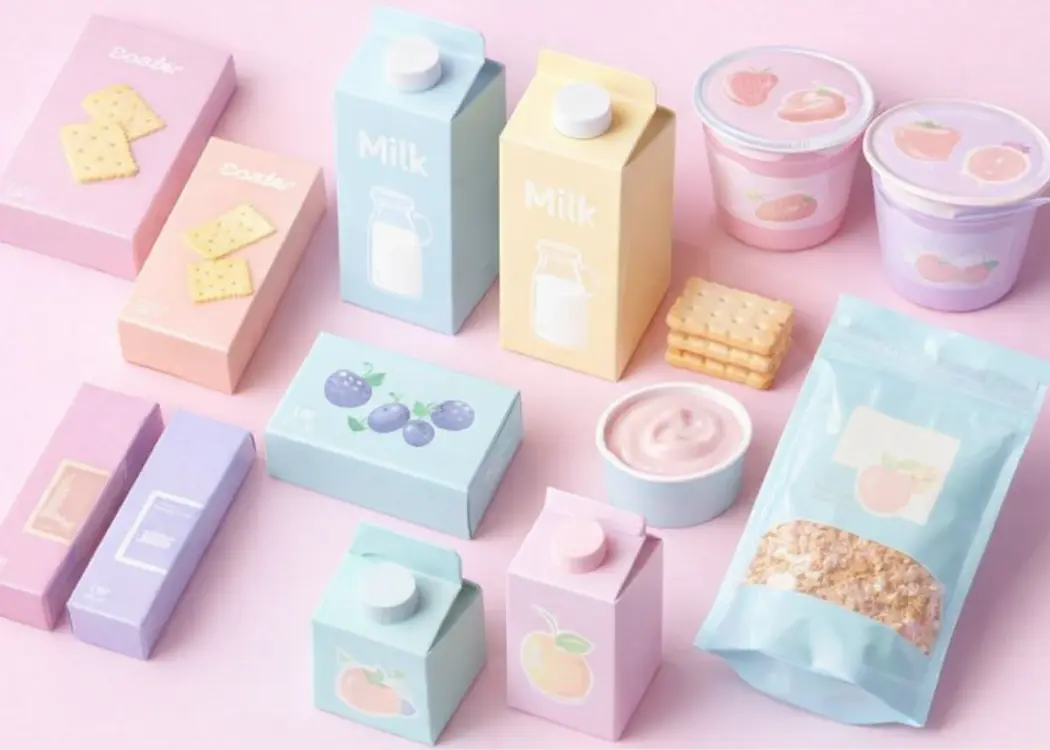
Pastel colors are low-saturation tones created by adding white to a base hue. The result is a softer, lighter, and more subdued appearance.
Common examples include blush pink, mint green, lavender, powder blue, and pale yellow.
These colors are often associated with:
- clean and modern branding
- premium positioning
- understated visual identity
From a design perspective, they are appealing. From a production perspective, they are inherently sensitive.
The Production Reality: Low-Saturation Colors Are Hard to Control
In print, pastel tones are among the least robust color choices.
Their visual subtlety leaves very little margin for variation. Small shifts in production conditions can lead to noticeable differences in the final result.
Key influencing factors include:
- substrate (material tone and absorbency)
- printing technology and calibration
- ink density and layering
- surface finishing (e.g. matte vs gloss)
Even when processes are well managed, these variables introduce risk.
Typical outcomes include:
- inconsistency between print runs
- variation across materials and formats
- shifts in temperature (warmer, cooler, duller tones)
- reduced on-shelf differentiation
The lighter the color, the more sensitive it becomes.
In mature production environments, these risks are usually identified early—but they still require deliberate design decisions to manage effectively.
Why This Matters Beyond Aesthetics
Color inconsistency is not just a technical issue—it has direct commercial impact.
When color systems are not robust:
- products become harder to distinguish
- brand recognition weakens
- rework and reprints increase costs
- timelines are affected
In high-volume packaging systems, even minor deviations can influence consumer choice.
Case Study: Arla — Ensuring Color Works Where It Matters
What was at stake
Arla needed clear differentiation between yoghurt variants on shelf, where color plays a key role in fast product recognition.
The visual direction included soft, low-saturation tones—introducing a known production risk in terms of color separation and consistency.
Collabra approach
From the outset, the focus was not only on how the design looked, but how it would perform in print.
Recognizing the sensitivity of the chosen color range, print expertise was integrated early in the process. This made it possible to assess and address potential risks before production.
Execution
Collabra’s print manager analyzed the Tetra Brik printing conditions and adjusted color values to ensure reliable differentiation between products.
Decisions were guided by real production behavior rather than digital appearance alone.
Outcome
- clear and consistent product differentiation on shelf
- predictable print results across runs
- reduced risk of rework and delays
- efficient ink usage without compromising clarity
Lifecycle shift
From visually driven decisions → to production-informed design from the start
Key Principle: Design for Performance, Not Just Appearance
Packaging does not exist on screen—it exists in a physical production environment.
The objective is not to reproduce a color perfectly in theory, but to ensure it performs consistently in reality.
Pastel tones are often selected based on digital appearance. Without aligning that choice with production conditions, the outcome becomes unpredictable.
A More Reliable Ways to Achieve a “Soft” Aesthetic
A pastel-like look can be achieved without relying on fragile color values.
More robust approaches include:
- using slightly higher saturation to improve control
- introducing contrast to support product differentiation
- leveraging materials and finishes (e.g. matte surfaces) to create softness
- validating color decisions against real print conditions early
These strategies maintain the desired visual tone while improving consistency and scalability.
When Pastels Can Be Appropriate
Pastel colors are not inherently wrong—but they require controlled conditions.
They are more suitable when:
- production volumes are limited
- materials remain consistent
- printing conditions are tightly managed
- some variation is acceptable
In large-scale, multi-market environments, they are rarely the most reliable option.
The Operational Perspective
As packaging portfolios grow, maintaining color consistency becomes more complex.
Teams must coordinate:
- multiple SKUs and variants
- different suppliers and print processes
- ongoing artwork updates
- regulatory changes
Sensitive color systems increase this complexity significantly.
This is where structured workflows and early integration of print expertise become critical.
Conclusion
Pastel packaging offers a refined and modern aesthetic—but it comes with production trade-offs that are often underestimated.
In practice:
- low-saturation colors are difficult to reproduce consistently
- results vary across materials and print conditions
- maintaining clarity and differentiation becomes more challenging
For most brands, the more effective approach is to align design decisions with production realities from the beginning.
Because in packaging, success is not defined by how something looks on screen—but by how reliably it performs on shelf.

 Tilda Eriksson
 Tilda Eriksson : 2026-08-28 16:19


 Ekaterina Skalatskaia : 2024-08-12 08:00