
 William Janeway
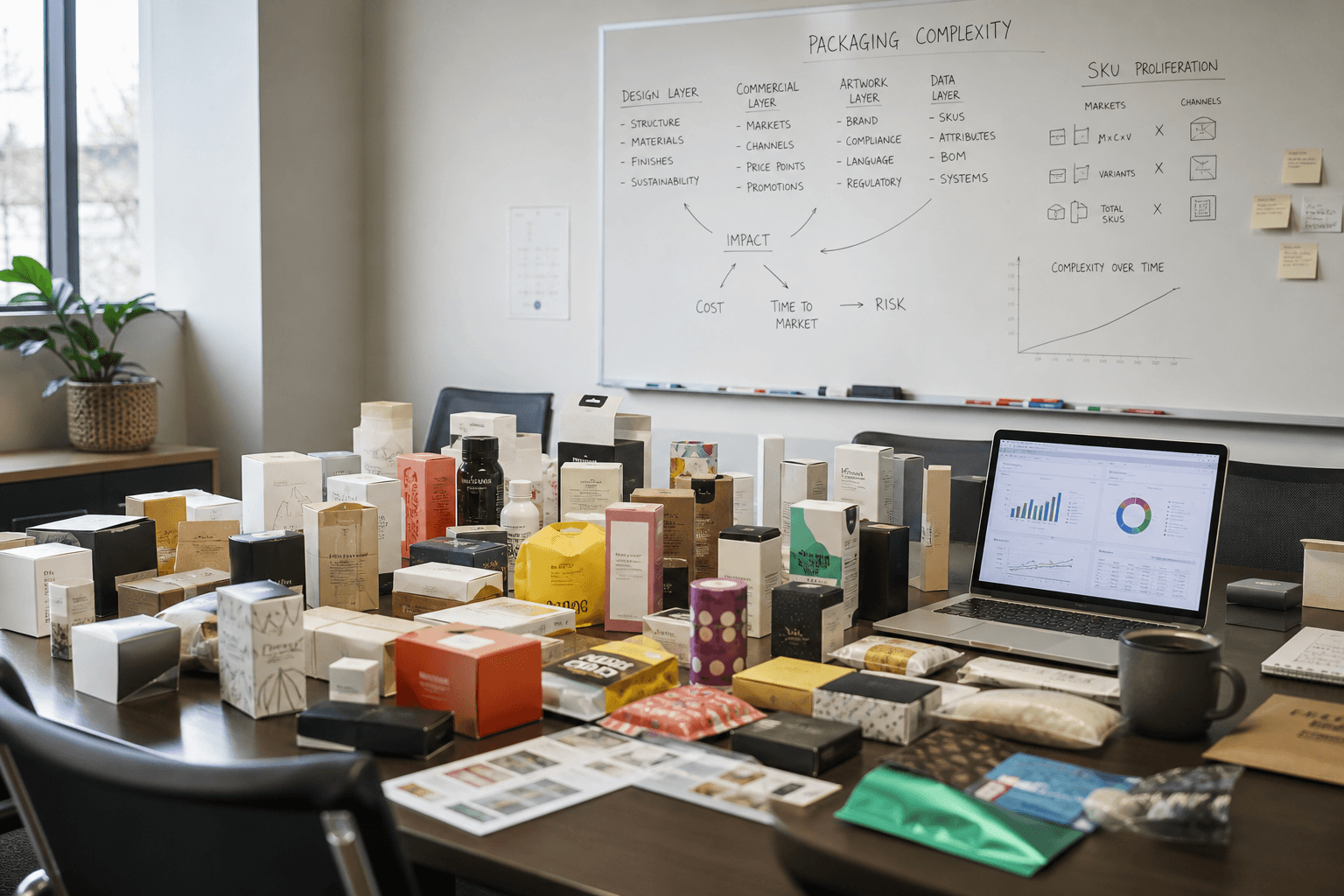
No brand decides to have 400 SKUs. It happens one small "yes" at a time: a new flavour, a retailer-specific pack, a special edition that never ended. This article explains how packaging complexity builds up, what it really costs and how to decide which variants deserve their place.
Key takeaways
- SKU proliferation is the steady growth in the number of product and packaging variants, often without a matching growth in sales.
- Packaging complexity builds up over years, as individual requests are approved without looking at the whole portfolio.
- Complexity has four layers: design, commercial, artwork, and data and production.
- In most portfolios, a small share of SKUs causes a large share of the workload, exceptions and cost.
- The goal is not less variety. The goal is variety that earns its cost.
What is SKU proliferation?
SKU proliferation is the growth in the number of stock keeping units (SKUs) in a product portfolio over time. In packaging, it means more pack sizes, more variants, more market versions and more artwork files to manage.
Some growth is healthy. New products and new markets bring new SKUs. SKU proliferation becomes a problem when the number of variants grows faster than their value, and the cost of managing them is not visible to anyone.
At Collabra, we have worked with packaging portfolios with thousands of articles for more than 20 years. We often meet brands that feel their portfolio has become hard to control, but cannot say exactly where the complexity sits or what it costs.
How does packaging complexity build up over time?
Packaging complexity builds up because each new variant is approved on its own, without anyone tracking what all the approvals add up to. Every single request makes sense. Together, they create a portfolio that is expensive and hard to manage.
A typical pattern looks like this:
- A retailer asks for a special pack size. It is approved to keep the listing.
- Marketing launches a limited edition. It sells well enough that nobody stops it.
- A new market needs its own version. The team builds a new master instead of adapting an existing one.
- A design refresh is rolled out to some products but not others. Now there are two design families.
After a few years, the portfolio contains variants that nobody would approve today, but nobody has taken the decision to remove them.
What are the four layers of packaging complexity?
Packaging complexity has four layers. Each one adds cost in a different way, and they often feed each other.
Design complexity
Design complexity comes from design families and templates that differ without a clear reason. Every extra template means more files to maintain, longer reviews and more chances for inconsistency.
Commercial complexity
Commercial complexity comes from low-volume variants, pack sizes that overlap and offers that duplicate each other. These increase the number of SKUs without increasing revenue in the same way.
Artwork complexity
Artwork complexity comes from too many master files, heavy localisation work and one-off manual exceptions. This is where artwork teams often lose the most time, usually without anyone noticing.
Data and production complexity
Data and production complexity comes from different naming rules, duplicate product IDs and specifications that are not linked to the right data. Every production run then becomes a small investigation.
What does SKU proliferation really cost?
SKU proliferation costs more than most brands see, because the costs are spread across many teams and budgets. The price of a new variant is visible at launch. The cost of keeping it alive for years is not.
Common hidden costs include:
- Artwork and file management: more masters and versions to create, check and store
- Review and approval time: more jobs for brand, regulatory and quality teams
- Print set-up: more print plates, colour checks and small print runs
- Minimum order quantities: small variants often need more packaging than they sell
- Inventory and write-offs: more stock to hold and more obsolete packaging when changes happen
- Change cost: every ingredient, claim or regulatory update must be made many times
The last point is often the biggest. When new rules such as PPWR require changes to labels or recycling marks, every extra variant is one more pack to update. We explain the full cost of poor control in invisible costs: how poor artwork management hurts packaging.
Is it complexity or variety?
Complexity and variety are not the same thing. Variety is the range of choices a brand offers its customers. Complexity is the cost and effort needed to deliver that range.
Good variety creates value: it wins shelf space, meets real customer needs and supports growth. Bad complexity creates cost without value: templates that differ for no reason, pack sizes nobody buys, masters that could have been shared.
The aim of reducing packaging complexity is not to cut choice for customers. It is to keep the variety that earns its cost and remove the rest.
6 signs your portfolio has outgrown its structure
If several of these sound familiar, your packaging portfolio has probably grown faster than its structure:
- Nobody knows the exact number of masters. Different teams give different answers.
- Some SKUs have no clear owner. Nobody is responsible for their volume or margin.
- Similar products use different templates. The differences cannot be explained.
- The same product has several IDs. Different systems name it in different ways.
- Small variants cause most of the problems. Exceptions, rush jobs and errors keep coming from the same low-volume packs.
- Updates take much longer than expected. A simple change turns into a project because it affects so many variants.
Questions to ask before approving a new SKU
The best way to stop complexity from growing is to ask the right questions before a new variant is approved. A simple check can include:
- What customer need does this variant meet that existing SKUs do not?
- What sales volume and margin do we expect, and when will we review it?
- Can it use an existing master or template?
- Which markets, retailers and channels will need their own versions?
- Who owns this SKU after launch?
- What will it cost to update when ingredients, claims or regulations change?
- When, and on what criteria, will we remove it if it does not perform?
When these questions are part of the approval process, new SKUs are added on purpose, not by habit.
How do you start SKU rationalization?
You start SKU rationalization by getting a clear, fact-based picture of your portfolio before cutting anything. A practical approach looks like this:
- Map the full portfolio. List every SKU with its volume, margin, markets and number of artwork files.
- Find where complexity sits. Look for the SKUs, templates and masters that create the most work and exceptions.
- Separate value from habit. Decide which variants earn their place and which exist only because nobody removed them.
- Consolidate where you can. Merge templates and masters where the difference does not add value.
- Set rules for the future. Agree clear criteria for approving and reviewing new SKUs.
This is also where structure across markets matters. If every market builds its own masters, complexity grows with every launch. Our article on packaging localization shows how to let markets adapt without creating new masters each time.
How Collabra helps brands reduce packaging complexity
Collabra is a packaging agency based in Gothenburg, Sweden. We help brand owners with packaging strategy, design and production, from portfolio decisions to print-ready artwork.
Our work with Apoteksgruppen is a good example. The company needed to modernise a large private-label range across many categories while keeping shoppers' recognition and allowing cost-efficient redesigns over time. Instead of treating it as a one-off redesign, Collabra created a clear design architecture that defined how categories align, differ and develop within one brand system. Guidelines and toolkits then made future projects easier and more predictable. You can read more on our work page.
We help brands reduce packaging portfolio complexity by mapping where it really sits, across design, commercial, artwork and data layers, and building the rules that stop it from growing back. A Packaging Complexity Audit gives you a fact-based map of where the cost is and where the savings are.
