Packaging approval is not the end of the process. Once a pack is launched, changes continue: copy is updated, regulations evolve, products are reformulated, markets introduce new requirements, and approved artwork is adapted for different channels.
Without a clear change management process, these updates can quickly create version drift across printed packs and digital derivatives. This article explains how to manage packaging changes after launch, keep every version connected to the approved master, and make ownership clear at every step.
Key takeaways
- Packaging does not end at approval. Most packs change several times during their life on the shelf.
- Packaging change management means handling every change after launch through a clear, controlled process.
- Digital derivatives are the formats created from one approved master, such as e-commerce images, retailer files and local variants. Each one must stay linked to that master.
- Version drift happens when a change reaches the printed pack but not every derivative.
- The fix is one approved master, a list of every place it is used, and a named owner for each change.
What is packaging change management?
Packaging change management is the process of handling changes to packaging that is already on the market. It covers updates such as new ingredients, changed claims, new regulatory text, new recycling marks and redesigns.
A good change process makes sure every change is checked, approved and applied everywhere the pack appears. That includes the printed pack, but also web shops, retailer systems, marketing materials and local market versions.
At Collabra, we have worked with packaging for FMCG brands for more than 20 years. We see the same thing in many companies: teams put a lot of effort into the launch, but much less into what happens after it. Yet for most products, the time after launch is far longer than the time before it.
Why doesn't packaging end at approval?
Packaging doesn't end at approval because products, rules and channels keep changing after launch. A pack that was correct on launch day can be out of date a few months later.
Common reasons for changes after launch include:
- Recipe or ingredient changes. A supplier changes, a new ingredient is used or a nutrition value is updated.
- New or changed claims. A product gets a new certification, or a claim must be removed.
- Regulatory updates. New rules require new text, symbols or markings.
- Retailer requests. A retailer asks for a new code, format or image.
- Design refreshes. The brand updates its look, one product family at a time.
Each of these changes affects not only the printed pack but every version of it that exists elsewhere.
What are digital derivatives in packaging?
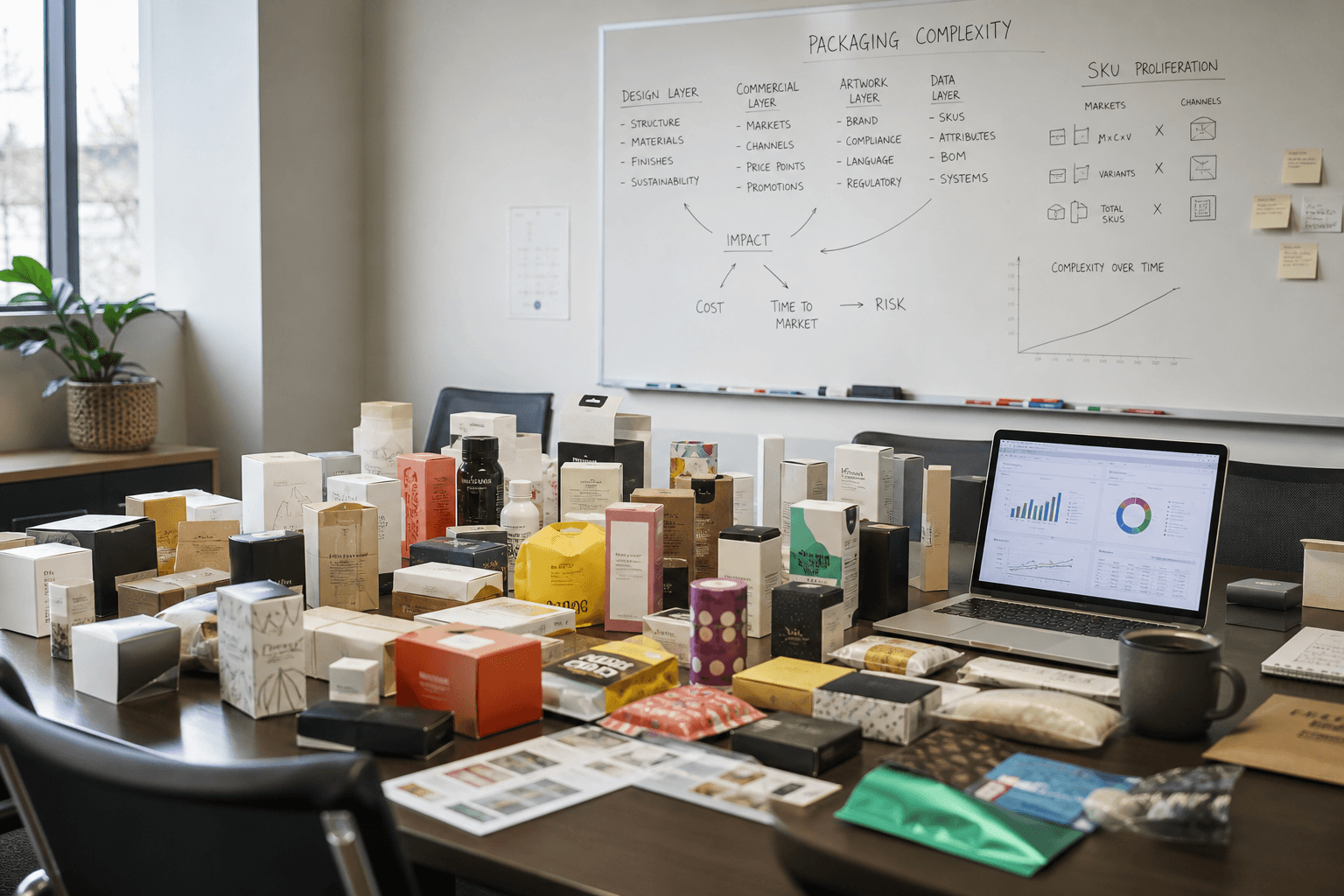
Digital derivatives are all the formats and versions created from one approved packaging master. They are copies or adaptations of the pack used in other channels and markets.
Typical digital derivatives include:
| Derivative |
Where it is used |
What can go wrong |
| E-commerce pack shots |
Web shops, online grocery |
Old image still shows the previous claim |
| Retailer asset files |
Retailer product databases |
Outdated ingredient list stays online |
| Local market variants |
Other countries and languages |
Change reaches one market but not others |
| CGI renders and 3D models |
Marketing, e-commerce, presentations |
Render still shows the old design |
| Marketing materials |
Campaigns, POS, social media |
Campaign uses a pack that no longer exists |
| Print files per supplier |
Different printers and formats |
One printer receives an older version |
When the master changes, every derivative must change too. If even one is missed, the brand shows different information in different places. In the worst case, a customer reads an outdated allergen list online.
What happens when one ingredient changes?
Here is a simple example. A dairy brand changes one ingredient in a yoghurt. The change seems small, but it has to reach many places:
- The master artwork for the main market
- Each local language version of the pack
- Print files for every printer and pack size
- The nutrition and allergen data in the product database
- E-commerce pack shots in every web shop
- Product data in each retailer's system
- CGI renders used in marketing
- Multipacks and promotional packs that include the product
- Point-of-sale materials still in use
- Social media and campaign assets
- Product information on the brand's own website
- Any documentation shared with sales teams
If the change is handled through email and memory, some of these places will be missed. The printed pack will be right, but the web shop will still show the old ingredient.
This is why post-launch changes need the same controlled process as the original launch.
How do you manage packaging changes after launch?
You manage packaging changes after launch by treating every change as a small project with a clear owner, a clear scope and a clear end. A simple approach looks like this:
- Start from the approved master. Every change begins with the current, approved version, never with an old copy.
- List every derivative. Keep an overview of every place the pack is used, so you know what the change will affect.
- Name one owner for the change. One person is accountable for making sure the change reaches every derivative.
- Use the same approval steps as before launch. Regulatory and quality checks apply to changes, not just to new packs.
- Close the change only when all derivatives are updated. A change is not done when the printed pack is ready. It is done when every version is correct.
Clear ownership is the part most teams miss. We explain how to assign it in our guide to building a packaging approval RACI.
Why do packaging stages get disconnected?
Packaging stages get disconnected because each stage often has its own team, its own files and its own way of tracking status. Design, artwork, approval, production and post-launch changes can end up working like separate processes.
Every handoff between these stages is a risk. Information can be lost, files can be copied instead of shared, and nobody has a full view of what is current. What gets approved is not always what gets produced, and what gets produced is not always what appears online.
The solution is to manage the full packaging lifecycle as one connected process, from the first design to the last change before a product is discontinued. When all stages share one master and one view of status, changes flow through the whole chain instead of stopping at the first handoff.
How can brands keep product visuals up to date?
Brands can keep product visuals up to date by creating visuals that are easy to change, instead of producing new ones from scratch for every update.
Collabra's work with Mills is a good example. Mills needed consistent product visuals across a growing range and many channels. Traditional photoshoots would have meant high costs and long lead times every time a product or claim changed. Collabra recommended moving to CGI-based visual production. Accurate CGI pack models made it possible to update visuals faster when products or content changed, with less need for repeated photoshoots and more consistent visuals across channels.
For e-commerce, clear rules also help. With Estrella, Collabra created guidelines for how brand, product name and claims should appear at small sizes on mobile. These rules keep product families consistent and aligned with existing pack shots, even as the range changes. Both projects are described on our work page.
For more on this topic, see why e-commerce success starts with perfect pack shots.
How will PPWR affect packaging changes?
The EU's Packaging and Packaging Waste Regulation (PPWR) will lead to many packaging changes over the coming years. New requirements for recyclability, material information and harmonised labels mean that large parts of existing ranges will need updates.
For brands, this is a post-launch change on a large scale. Packs that are already on the market must be updated, often across many markets at the same time. Brands with a clear change process can plan these updates as one structured rollout. Brands without one risk handling each update separately, with a higher chance of missed derivatives.
We summarise the key deadlines in PPWR and packaging: what brands must do before 2030.
How Collabra helps brands manage the packaging lifecycle
Collabra is a packaging agency based in Gothenburg, Sweden. We work with brand owners on packaging strategy, design and production, covering the whole journey from concept to shelf and every change after launch.
We help brands connect design, artwork, approval, production and post-launch changes into one process. That includes setting up clear handoffs between teams, keeping approval decisions tied to production requirements, and making sure e-commerce assets, retailer files and local variants stay aligned with the approved master.
If you want to see where your lifecycle breaks down, a lifecycle consultation with Collabra is a good place to start.

 Tilda Eriksson


 William Janeway : 2026-10-12 10:15

 Tilda Eriksson