
 Tilda Eriksson
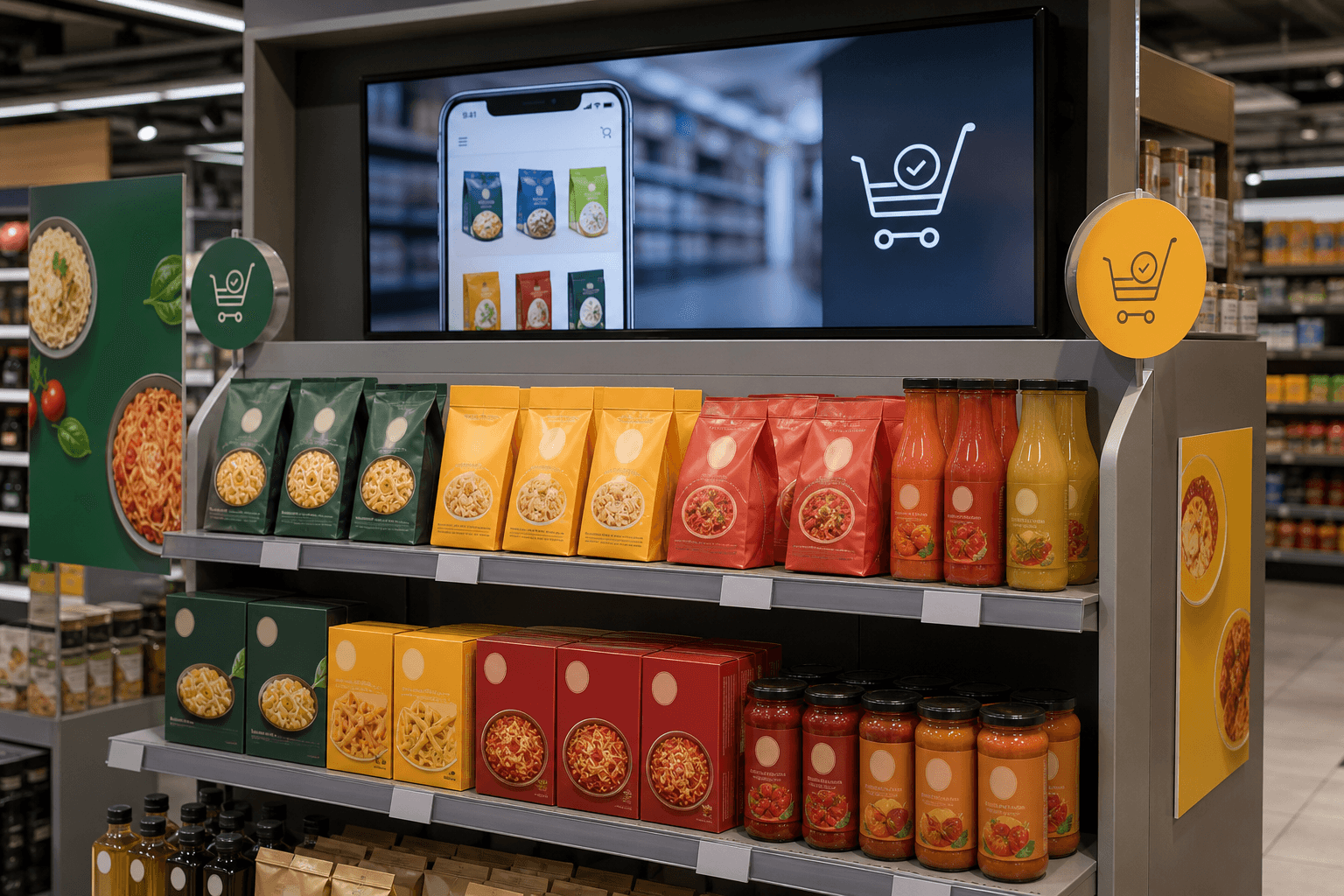
A pack used to have one job: stand out on the shelf. Today the same design must also work as a tiny image on a phone, on a promotion stand, in ten markets and on real printing presses. This article explains what good FMCG packaging design looks like now, and what we have learned at Collabra from designing for all these places at once.
Key takeaways
- Modern FMCG packaging design must work on shelf, on screen, in print, at the point of sale and across markets.
- A design that looks good in a presentation can fail in print or at small sizes online. Test it early where it is hardest.
- Mobile Ready Hero Images (MRHI) help products stay recognisable in mobile e-commerce.
- Brand architecture keeps every SKU consistent, including line extensions, limited editions and seasonal packs.
- POS material and CGI work best when they are planned together with the packaging design, not after it.
What makes FMCG packaging design work today?
FMCG packaging design works today when it performs in every place a shopper meets the product, not only on the shelf. A strong design is easy to recognise, easy to adapt and easy to produce.
In practice, that means three things:
- Recognition. Shoppers find the product quickly, whether they see it in a store, on a stand or on a phone screen.
- Consistency. Every SKU, market and channel clearly belongs to the same brand.
- Producibility. The design works on real materials, pack sizes and printing processes, not only on screen.
Collabra has designed packaging for FMCG brands since 2003, for brands such as Cloetta, Malaco, Tork, Estrella and Apoteksgruppen. The most common problem we see is not a lack of creativity. It is a design that was only tested in one place.
Where does packaging design need to perform?
Packaging design needs to perform in at least five places. Each one has different needs, so each one needs clear design rules.
| Touchpoint | What the shopper needs | Key design rule |
|---|---|---|
| Store shelf | Find the brand and variant in seconds | Strong brand block, clear colour coding |
| Mobile e-commerce | Recognise the product at thumbnail size | Simplified hero image with brand, product, variant and size |
| Point of sale | Notice the offer from a distance | POS designed as part of the packaging system |
| Other markets | Trust that it is the same brand | Fixed core elements, clear local adaptation rules |
| See the colours and details as intended | Design checked against real print behaviour |
A design that fails in one of these places costs sales, time or money. That is why the best time to test all five is during design, not after launch.
Why must packaging design work in print?
Packaging design must work in print because colours, details and contrast look different on real materials than on a screen. A design that is correct on a monitor can confuse shoppers on the shelf.
A clear example comes from our work with Arla. A vanilla yoghurt was being mistaken for strawberry because of how its colour appeared in print. The issue was not the design idea but how the colour behaved on the real packaging. Collabra's print manager adjusted the colour values to the actual printing process, which fixed the difference on shelf and even reduced ink use.
The lesson is simple: print knowledge belongs in the design process. We explore a similar challenge in pastel packaging: a beautiful idea that doesn't always work in print.
How do you design packaging for e-commerce?
You design packaging for e-commerce by making sure the product is easy to recognise at very small sizes on a phone. In mobile shopping, the product image is often no bigger than a thumbnail, so detailed packs can become hard to read.
This is where Mobile Ready Hero Images (MRHI) help. An MRHI is a simplified product image made for mobile screens. It focuses on the key information a shopper needs: the brand, the product, the variant and the size.
Collabra took part in the consortium that developed the global MRHI guidelines, together with GS1, Cambridge University and many of the world's largest brands and e-commerce retailers. We have also worked with MRHI in Scandinavia for more than a decade.
For Estrella, we used a "less is more" approach. We simplified hero images, removed non-essential elements and made key details stronger. We also created guidelines to keep the whole product family consistent. The result was better recognition on mobile and clearer choices for shoppers. For more on this topic, see why e-commerce success starts with perfect pack shots.
How does brand architecture keep every SKU consistent?
Brand architecture keeps every SKU consistent by defining how products, categories and variants relate to each other visually. It is the set of rules that decides what all packs share and how they can differ.
Brand architecture becomes important when a range grows. Line extensions, limited editions, seasonal packs and co-branded products all need to feel new, while still clearly belonging to the brand.
Our work with Apoteksgruppen shows why this matters. The company needed to modernise a large private-label range across many categories. Instead of a one-off redesign, Collabra created a clear design architecture that defined how categories align and differ within one brand system. Guidelines and toolkits then made future redesigns step by step, cost-efficient and predictable.
Brand architecture also makes multi-market work easier. When every market starts from the same system, adapting packs to local needs does not break the brand. Our article on packaging localization explains how to decide what stays fixed and what can flex.
Why should POS and CGI be part of packaging design?
POS and CGI should be part of packaging design because they show the same product to shoppers in other places. When they are planned separately, the brand can look different in-store, online and on the pack.
POS material, such as shelf strips, wobblers, stands and posters, works best when it is designed with the packaging from the start. It then extends the design instead of competing with it.
CGI, or computer-generated imagery, creates realistic product images directly from the design files. This makes it possible to prepare images for e-commerce and marketing before the artwork has received its final approval, so products can be ready online as soon as they launch.
For Mills, Collabra moved product visuals to a CGI-based model. This reduced the need for repeated photoshoots and made it faster to update images when products or claims changed. You can read more about these projects on our work page.
What should you look for in a packaging design partner?
A good packaging design partner creates designs that look strong and also work in every channel, market and print process. When you choose a partner, look for:
- Experience across touchpoints. Shelf, e-commerce, POS and CGI should be designed as one system.
- Print and production knowledge. The partner should know how designs behave on real materials.
- Brand architecture skills. A growing range needs rules, not only individual designs.
- Multi-market experience. Adapting packaging to local markets should not weaken the brand.
- Ability to work with other agencies. Many brands use several creative partners. A good design partner fits into that setup.
- One clear process. Brands should spend their time on the brand, not on managing vendors.
How Collabra approaches packaging design
Collabra is a packaging agency based in Gothenburg, Sweden. Our packaging design services cover packaging design, content design, POS material, CGI and e-commerce design. That includes adaptive design for multi-market rollouts, line extensions, limited editions, seasonal packs, co-branding and brand architecture.
What makes our approach different is that design never works alone. It connects with our packaging strategy work before the design starts, and with our production team, including print managers and proofing, after it. Every project moves through one coherent process, and we work alongside a brand's other agencies when needed.
The result is packaging that keeps its strategic idea from the first concept to the shelf, the screen and the printed pack.
