Most packaging problems don't start inside a team. They start in the space between two teams, when work moves from one person to the next. This article shows the seven handoffs where packaging projects most often break down, and what you can do to fix each one.
Key takeaways
- A packaging handoff is the moment work moves from one team, person or supplier to the next.
- Most packaging errors and delays happen at handoffs, not inside a single team.
- The seven most critical handoffs run from brief to design, all the way to digital assets and local markets.
- In 2026, handoffs are under more pressure because of new rules such as PPWR, more digital channels and more suppliers.
- A good handoff has five parts: clear inputs, one owner, one current file, a clear definition of done and a recorded decision.
What is a packaging handoff?
A packaging handoff is the point where work on a pack moves from one team, person or supplier to another. For example, when the brand team hands a brief to the design agency, or when the artwork studio sends an approved file to the printer.
A single pack can pass through ten or more handoffs before it reaches the shelf. Each one is a moment where information can be lost, files can be copied or decisions can be misunderstood.
At Collabra, we have worked with packaging for FMCG brands for more than 20 years and across 600+ artwork programs. In our experience, the teams themselves usually do good work. The problems appear in the gaps between them.
Why do packaging handoffs break down?
Packaging handoffs break down because each team works with its own files, its own tools and its own idea of what "done" means. When work moves between teams, these differences create gaps.
The most common causes are:
- Missing information. The next team does not get everything it needs to start.
- Unclear ownership. Nobody is sure who is responsible for the work during the handoff.
- Several versions of the same file. The next team starts from an old copy instead of the current file.
- Different definitions of "done". One team thinks the work is finished, the next team thinks it isn't.
- Decisions that are not recorded. Agreements made in meetings or emails do not follow the file.
The 7 packaging handoffs that break most often
These are the seven handoffs where we see packaging projects break down most often.
1. Brief to design
What goes wrong: The brief is incomplete or changes after design has started. Key information, such as claims, pack sizes or target markets, is missing.
How to fix it: Use a fixed brief template. Agree that design starts only when the brief is approved and complete.
2. Design to artwork
What goes wrong: The creative design looks good in presentations but does not work on every pack size, material or language version. The artwork team has to solve design problems late.
How to fix it: Involve artwork and production experts during design, not after it. Test the design on the most difficult pack format early.
3. Product data to artwork
What goes wrong: Ingredients, nutrition values or product codes change after artwork has started, and the artwork team is not told. This is one of the most common sources of compliance errors.
How to fix it: Name one owner for product data. Agree that any change to data after artwork starts must be sent directly to the artwork team.
4. Artwork to review and approval
What goes wrong: Many people review the file, but nobody is sure who makes the final decision. Feedback comes in through email, chat and meetings, and some of it gets lost.
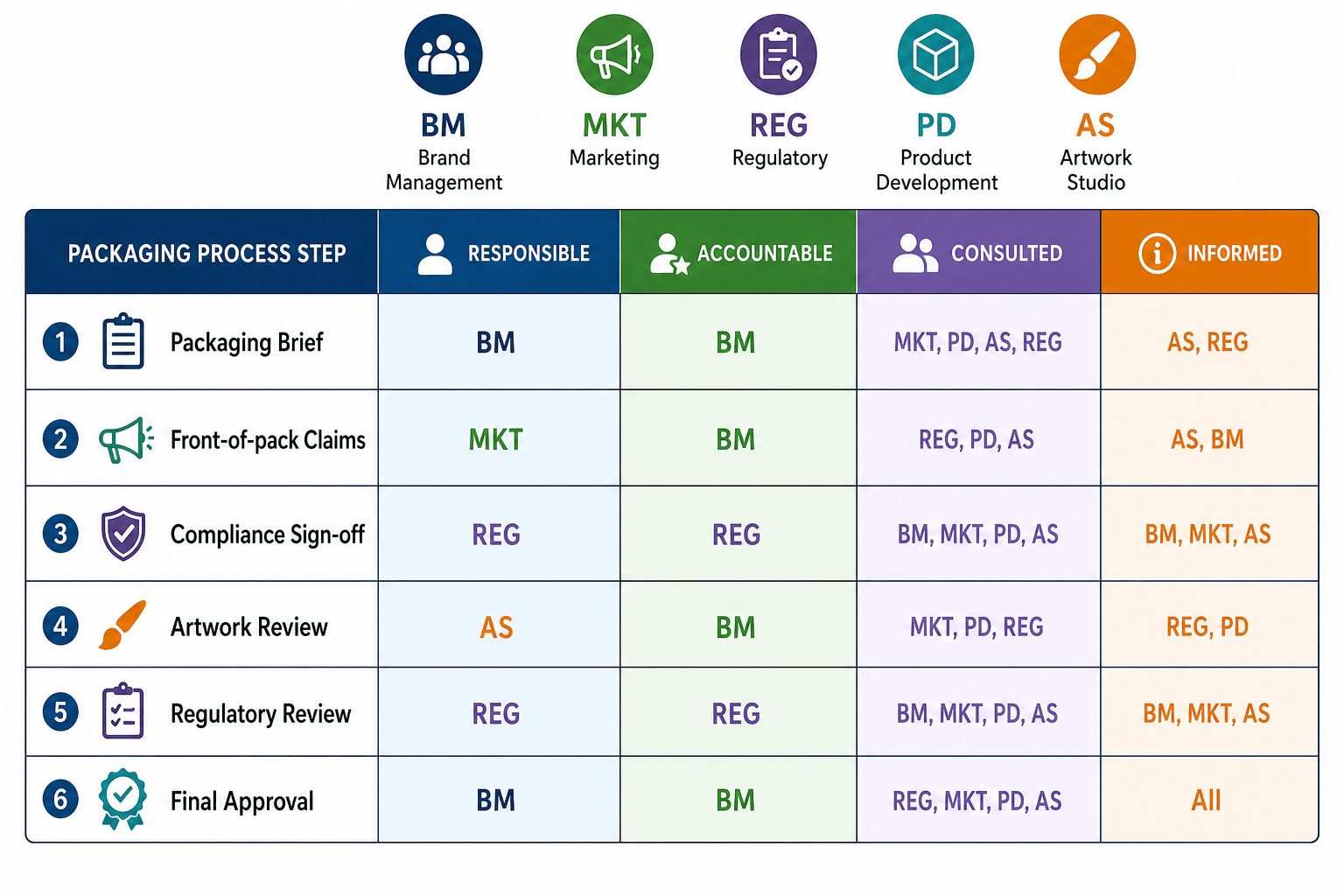
How to fix it: Give every approval step one named decision-maker. Collect all feedback in one place. Our guide to a packaging approval RACI shows how to set this up.
5. Approval to print
What goes wrong: The approved file and the file sent to print are not the same. Or the file is correct, but colours behave differently on the real material.
How to fix it: Use strict version control so only the approved file can be sent to print. Include print expertise before approval, not only after it. We explain why in how to reduce artwork errors with version control.
6. Print master to digital assets
What goes wrong: The printed pack is updated, but e-commerce images, retailer files and marketing materials still show the old version.
How to fix it: Keep a list of every digital asset created from each master. Treat a change as finished only when every asset is updated.
7. Global to local markets
What goes wrong: Local teams start from different versions of the master and adapt it in their own way. Over time, the brand looks different in every market.
How to fix it: Let every market start from the same approved master. Define clearly what local teams can and cannot change. Our article on packaging localization explains a simple model for this.
Handoff overview: typical failures and fixes
| Handoff |
Typical failure |
Key fix |
| Brief → design |
Incomplete or changing brief |
Fixed brief template, approved before start |
| Design → artwork |
Design doesn't work on all formats |
Involve artwork experts during design |
| Product data → artwork |
Data changes without notice |
One data owner, direct change alerts |
| Artwork → approval |
No clear decision-maker |
One owner per approval step |
| Approval → print |
Wrong file or print surprises |
Version control and early print checks |
| Print master → digital |
Online assets out of date |
List of all derivatives per master |
| Global → local |
Markets drift apart |
Shared master and clear local rules |
What makes packaging handoffs harder in 2026?
Packaging handoffs are harder in 2026 because there are more requirements, more channels and more people involved in every pack.
Four changes stand out:
- PPWR. The EU's Packaging and Packaging Waste Regulation applies from August 2026. It brings new requirements for recyclability, labelling and material information. These add new checks and new owners to the process, which means new handoffs. We summarise the key steps in PPWR and packaging: what brands must do before 2030.
- More digital channels. One pack now needs images and data for web shops, retailer platforms and social media. Each channel adds a handoff after print.
- More suppliers and partners. Many brands work with several agencies, artwork studios and printers across markets. Every new partner adds new handoffs.
- Faster updates. Claims, ingredients and designs change more often, so the same handoffs are repeated more times during a product's life.
What does a good packaging handoff look like?
A good packaging handoff has five parts. If one is missing, the handoff is at risk.
- Clear inputs. The receiving team knows exactly what it needs before it starts.
- One owner. One named person is responsible for the work during the handoff.
- One current file. Everyone works from the same approved version.
- A clear definition of done. Both teams agree what "finished" means at this step.
- A recorded decision. Approvals and agreements are written down and follow the file.
These five parts turn a handoff from a risky moment into a routine step.
How do you find the weak handoffs in your process?
You find weak handoffs by following one real project from start to finish and noting where it slowed down or went wrong.
- Choose a recent, typical project. Not the easiest one and not the worst one.
- List every handoff. Write down each time the work moved to a new team, person or supplier.
- Mark delays and errors. Note where the project waited, where files were corrected and where information was missing.
- Check the five parts. For each problem handoff, check which of the five parts was missing.
- Fix the worst two or three first. In most processes, a few handoffs cause most of the problems.
How Collabra helps brands fix packaging handoffs
Collabra is a packaging agency based in Gothenburg, Sweden. We work with brand owners on packaging strategy, design and production. Because we work across the whole chain, from design to artwork, proofing and print management, we see every handoff up close.
Some examples from our work:
- Arla: A vanilla yoghurt was being mistaken for strawberry because of how the colour behaved in print. Collabra's print manager recalibrated the colour values for the real printing process and brought print expertise into the design discussions. The design-to-print handoff became part of the design work instead of a late correction.
- Santa Maria: For more than 600 artworks across markets, suppliers and printers, Collabra designed the artwork architecture and planning before production started. The result was an average of 1.5 revisions per artwork and predictable timelines.
- Kavli: Design and artwork vendors were involved early in a cross-market adaptation project, which helped build a repeatable way of managing artwork across markets.
We help brands manage the full packaging lifecycle as one connected process, so work does not break between design, artwork, approval, production and changes after launch. If your handoffs are part of a wider process problem, we can also help you transform artwork operations with a clear operating model. A Packaging Operations Health Check is a good first step.

 William Janeway



 Tilda Eriksson : 2026-10-06 09:45

 William Janeway